
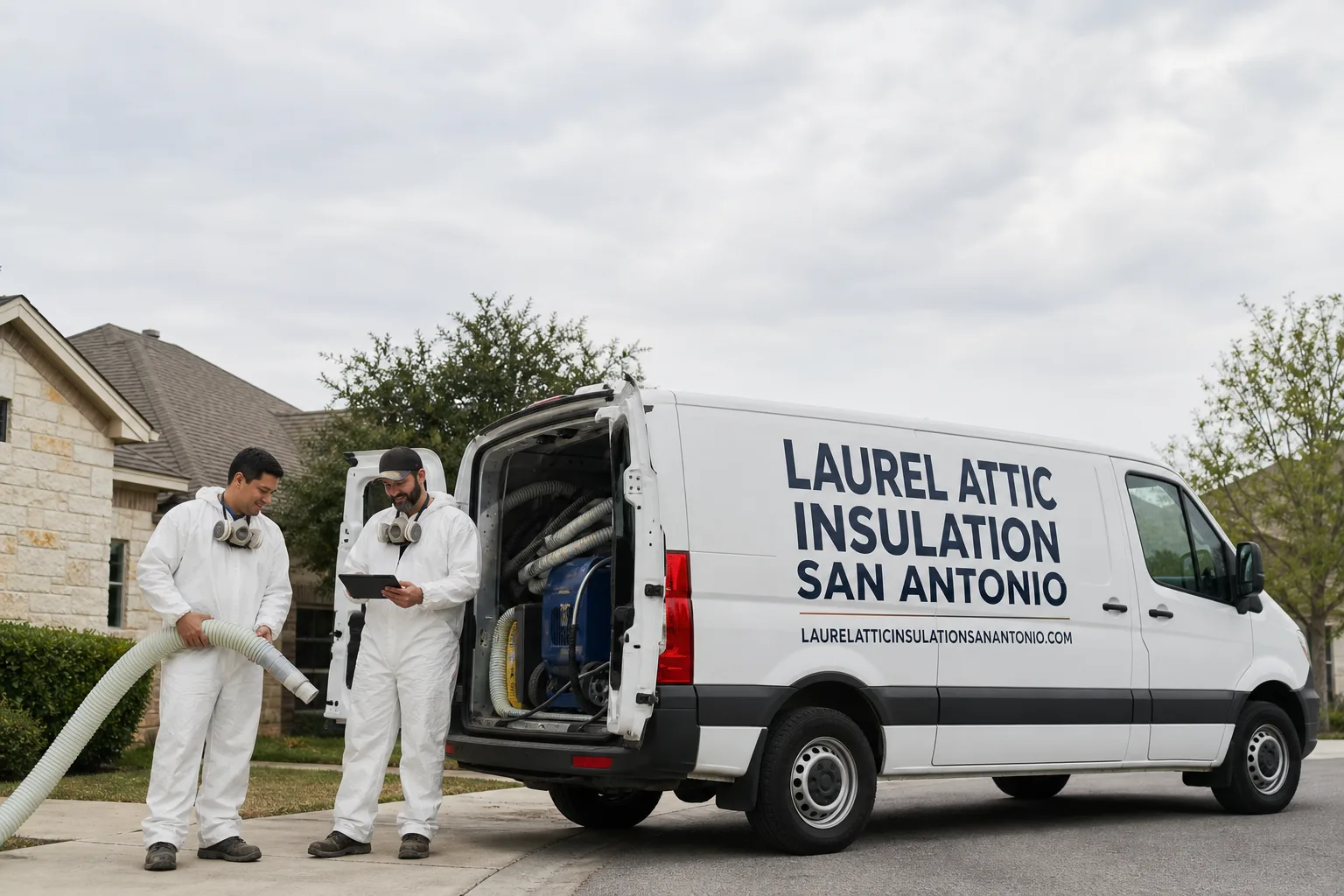
How Much Does Spray Foam Insulation Cost in San Antonio?
Our Spray Foam Insulation services in San Antonio typically run $1.50 to $4.75 per board foot installed, landing most whole-attic projects between $3,200 and $7,800 in 2026. Closed-cell foam costs roughly 50 to 70 percent more than open-cell, but it also delivers about double the R-value per inch. A standard 1,500-square-foot attic with open-cell spray foam on the roofline usually falls around $4,100 to $5,900 in San Antonio neighborhoods like Alamo Heights, Stone Oak, and Helotes.
Spray Foam Insulation Cost Breakdown (2026)
Line-item pricing for spray foam varies by foam type, application area, and how accessible the space is. Here’s what San Antonio homeowners should expect based on current regional contractor rates:
| Line Item | Open-Cell Foam | Closed-Cell Foam |
|---|---|---|
| Per board foot (material + labor) | $0.65 – $1.20 | $1.50 – $2.65 |
| Average attic roofline (1,500 sq ft attic) | $3,500 – $5,200 | $6,800 – $9,500 |
| Rim joist / band board sealing (full perimeter) | $850 – $1,400 | $1,600 – $2,600 |
| Exterior wall cavity fill (2×4, full house) | $2,800 – $4,300 | $4,700 – $6,800 |
| Floor / crawl space encapsulation | $2,200 – $3,400 | $4,000 – $5,800 |
| Detached garage or shop (full ceiling + walls) | $1,900 – $2,800 | $3,300 – $4,600 |
| Small patch / repair job (under 100 sq ft) | $350 – $650 minimum | $550 – $950 minimum |
These ranges reflect what our estimators have quoted across Bexar County over the past twelve months, adjusted for 2026 material pricing from manufacturers we stock including Icynene, Demilec, and CertainTeed. Most companies quote by the board foot, which measures one square foot, one inch thick. You’ll also see a minimum job charge, usually $350 to $650, because the foam rig has to be brought out, set up, and cleaned regardless of job size.
What moves the number? The three biggest factors are square footage of the surface being sprayed (not the floor area of the room), foam type, and prep work. Attics with existing insulation that needs removal first will add $1,200 to $2,800 on average. Tight attic access, low-pitch roofs under 4:12, and older homes with wiring that needs to be moved or protected all push labor hours up.
What Affects Spray Foam Insulation Pricing in San Antonio
- Open-cell vs. closed-cell. Open-cell foam is softer, breathable, and cheaper. Closed-cell is denser, adds structural rigidity, blocks moisture, and costs more per board foot. In San Antonio’s humid climate, closed-cell on the roofline prevents condensation problems we see regularly in older Alamo Heights and Monte Vista homes with shake or tile roofs.
- Attic geometry and access. A simple gable roof with 7-foot clearance prices lower than a hip roof with multiple valleys and short kneewalls. Homes in Terrell Hills and Olmos Park frequently have complex rooflines that add 15 to 25 percent to labor.
- Existing insulation condition. If your attic has old fiberglass batts, raccoon damage, or decades of dust from a Texas Hill Country cedar roof, removal is required before foam adheres properly. That’s a separate line item, as noted above.
- R-value target. San Antonio sits in IECC climate zone 2, but many homeowners spec R-38 to R-49 on the attic floor or roofline, which requires thicker foam. More inches equals more board feet equals more cost. Code minimums are lower, but the Texas heat means code minimum rarely feels like enough come August.
- Time of year. Spray foam pricing in San Antonio runs about 8 to 12 percent lower in February and early March when contractor calendars thin out. June through September? You’ll pay peak rates and wait two to three weeks. Late fall is the sweet spot for availability and stable pricing.
- Foam brand and density. Not all closed-cell foam is identical. Demilec and Icynene closed-cell products meter more consistently in high humidity, which matters when you’re spraying in a Texas summer dew point. Budget brands exist, but we don’t carry them. Re-spraying a failed cheap foam job costs more than doing it right once.
Open-Cell vs. Closed-Cell: Real Numbers for San Antonio Homes
The choice between open-cell and closed-cell is the single biggest pricing decision you’ll make. Here’s the straight comparison:
- Open-cell spray foam runs $0.65 to $1.20 per board foot. At R-3.7 per inch, a 6-inch roofline application gives about R-22, which is adequate for most Texas attics when paired with good ventilation. It’s air-permeable, so it won’t trap moisture. Weight is negligible, so it works on older ceiling joists without structural concerns.
- Closed-cell spray foam runs $1.50 to $2.65 per board foot. At roughly R-6.5 per inch, just 3 inches of closed-cell achieves higher R-value than 6 inches of open-cell. It acts as a vapor barrier, adds shear strength to roof decks, and blocks bulk water. We recommend it for metal roofs in the Hill Country and for any attic with existing moisture staining.
Most San Antonio attics with standard composition shingle roofs are excellent candidates for open-cell on the roofline at a lower price point. It’s not a compromise; it’s the right material for that application. The decision should follow the roof type, the attic’s ventilation profile, and whether the attic has any history of humidity or condensation. Our estimators at Laurel Attic Insulation walk through both options and quote both, so you can compare dollars against performance before committing.
Is Spray Foam Worth the Higher Upfront Cost vs. Fiberglass or Cellulose?
Compared to blown fiberglass at $0.50 to $0.90 per square foot of attic floor or cellulose at $0.60 to $1.10 per square foot, spray foam costs more upfront. The payoff comes in three places. First, spray foam seals air leaks, not just adds insulation value. Fiberglass and cellulose slow heat conduction but don’t stop air movement. In a 1900s-era King William District house with original framing, air leakage is the dominant energy loss, not conduction. Second, foam on the roofline moves the thermal boundary to the roof deck, which keeps the attic within a few degrees of the living space and protects ductwork. In San Antonio, where most ductwork lives in unconditioned attics hitting 140°F in July, this can cut cooling load by 20 to 35 percent. Third, foam doesn’t settle. Cellulose settles 10 to 15 percent over a decade. Fiberglass loses R-value when compressed or wind-washed. Spray foam’s R-value is permanent. When you amortize a $5,000 spray foam job over a 30-year roof cycle against the same fiberglass replaced every 12 years, the numbers tighten considerably.
How to Save on Spray Foam Insulation in San Antonio
Smart shopping doesn’t mean cutting corners on material or install quality. It means timing the project right and avoiding unnecessary prep charges.
- Book a winter or early-spring install. Contractor availability in San Antonio drops after the holidays. We’ve seen the same job quote 10 percent lower in February than in July simply because crews need the work. Call us in January, and you’ll likely get an earlier install date and a better rate.
- Handle the attic clean-out yourself. If your attic has old boxes, Christmas decorations, or a dead squirrel, removing those before the crew arrives saves an hour or two of labor. Leave the old insulation itself; that’s safety-gear work best left to pros.
- Bundle projects. Spraying the attic roofline and the rim joists in the same visit is significantly cheaper than two separate mobilizations. Adding a full spray foam attic treatment to an insulation removal job also consolidates setup and cleanup time.
- Get at least three written quotes, and compare board-foot pricing, not just the total. A lower total for fewer board feet isn’t a deal. Ask every contractor for the square footage they’re spraying, the foam type, the target R-value, and the price per board foot. Then line up the four numbers side by side.
- Ask about manufacturer rebates. Icynene and Demilec both run seasonal promotions. As a dealer for both, we pass those through when they’re active. They change quarterly, so call (254) 279-0971 and ask what’s currently available.
- Don’t skip the energy audit. CPS Energy and various state programs sometimes offer rebates or financing for insulation work. An audit tells you exactly where your leaks are, so you don’t pay to spray an area that isn’t the problem. We’ll work from any certified audit results you bring us.
Spray Foam vs. Traditional Insulation: Cost Comparison Table
| Insulation Type | Installed Cost (1,500 sq ft attic) | R-Value per Inch | Air Sealing? | Lifespan |
|---|---|---|---|---|
| Blown fiberglass | $800 – $1,500 | R-2.2 – R-2.7 | No | 10 – 15 years (settles) |
| Blown cellulose | $1,000 – $1,900 | R-3.2 – R-3.8 | Partial | 15 – 20 years (settles) |
| Fiberglass batts | $700 – $1,300 | R-2.9 – R-3.8 | No | 10 – 20 years (gaps form) |
| Open-cell spray foam (roofline) | $3,500 – $5,200 | R-3.5 – R-3.9 | Yes | 30+ years |
| Closed-cell spray foam (roofline) | $6,800 – $9,500 | R-6.0 – R-7.0 | Yes (vapor barrier too) | 30+ years |
These are San Antonio market numbers we update annually. Your home’s actual price depends on access, geometry, and existing conditions. We quote the real number in writing before any work starts, so you’ll never get a revised figure at the truck door.
How Much Does Spray Foam Insulation Cost Per Square Foot?
Homeowners ask this a lot, but the honest answer requires a distinction. When you hear “$1.50 to $4.75 per square foot” from a contractor, check whether that’s per board foot (one square foot, one inch thick) or per square foot of surface area at an assumed thickness. A 2-inch closed-cell application at $1.75 per board foot costs $3.50 per square foot of surface area. Same foam, different math. Ask for the board-foot rate, the total board feet to be installed, and the square footage of surface area. Those three numbers should reconcile. If they don’t, ask questions.
For attic floors using spray foam (less common than roofline application), a 1,200-square-foot attic at 2 inches of open-cell foam runs roughly $1,600 to $2,900. For wall cavities in a 2,000-square-foot single-story home, full open-cell cavity fill typically lands near $3,500 to $5,000 depending on stud spacing and depth.
What Does It Cost to Remove Old Insulation Before Spray Foaming?
If your attic has existing fiberglass batts, blown cellulose, or worse, vermiculite, removal is typically $1.20 to $2.60 per square foot of attic floor. For a 1,500-square-foot attic, that’s $1,800 to $3,900. The price climbs if there’s rodent damage, water damage, or if the attic has tight access that slows the vacuum operation. As a full-service shop, Laurel Attic Insulation does removal and spray foam in the same visit, which is cheaper than hiring two separate crews and coordinating two schedules. We’re the only insulation company in our market that brings full removal capability and the spray foam rig on the same truck.
Safety Note Before You Shop
Spray foam installation involves high-pressure two-component chemical systems that react exothermically, generating heat as they expand. The chemicals require proper personal protective equipment including supplied-air respirators during the spraying and curing window. You should also know that an improperly mixed batch can off-gas or fail to cure correctly, which is not just a performance problem but a health concern in an occupied home. This is not a DIY project, not even for an ambitious weekend. We run calibrated proportioning equipment, monitor temperature and humidity conditions before spraying, and our techs are trained in proper ventilation and re-occupancy timing. When you’re comparing quotes, ask the contractor how they handle re-occupancy timing and what their air quality verification procedure is. If you get a shrug, that’s a red flag.
FAQs – Spray Foam Insulation Cost
How much does spray foam insulation cost for a 1,500 sq ft attic in San Antonio?
Expect $3,500 to $5,200 for open-cell foam on the roofline and $6,800 to $9,500 for closed-cell, including labor and equipment. These are 2026 San Antonio rates for a standard gable or hip roof with reasonable access. The range tightens once we see the attic, and the written quote you get from us is the price you pay. Call (254) 279-0971 for an exact number on your home.
Is closed-cell spray foam worth the extra cost in San Antonio’s humidity?
Closed-cell costs about 50 to 70 percent more than open-cell, typically $2,000 to $4,000 more for a whole attic. If your home has a metal roof, a history of attic condensation, or you live in a flood-prone area near Olmos Creek or Salado Creek, the moisture-blocking and structural benefits justify the premium. For most composition-shingle homes, open-cell on the roofline is the pragmatic choice. We quote both on every estimate so you decide with real numbers in front of you.
Can you spray foam over existing fiberglass insulation?
No, spray foam must contact the surface directly to adhere. Foam sprayed over fiberglass batts will peel, gap, and fail. Removal adds $1,800 to $3,900 for a typical 1,500-square-foot attic. We handle removal and foam in one visit.
How long does a spray foam insulation job take?
Most San Antonio attics are sprayed in one day, with a 24-hour re-occupancy window for open-cell and about 2 to 4 hours for closed-cell before it’s safe to be in the home, though we recommend a full 24 hours for any project. Prep and removal add time. If removal is needed, the job totals two to three days. We tell you the exact schedule before the crew arrives, and we show up when we say we’ll show up.
Is spray foam insulation a tax credit or utility rebate in San Antonio?
Spray foam generally qualifies for the federal Energy Efficient Home Improvement Credit, which covers 30 percent of the insulation cost, up to $1,200 annually as of 2026, provided the foam meets applicable energy-efficiency criteria. CPS Energy has offered variable local rebates; their programs change year to year. Ask us and we’ll point you to current documentation. We also itemize insulation separately on your invoice so the tax filing is simple.
Why does spray foam cost more than blown-in insulation?
Spray foam costs 4 to 6 times more than blown fiberglass per square foot because the material itself is more expensive, the application requires a specialized high-pressure rig, and the labor demands training and certification. The tradeoff is a sealed air barrier, a permanent R-value, and no settling. For the right home and the right budget, it’s the highest-performance retrofit available in the Texas heat. For tight budgets, we’ll tell you honestly if spray foam is overkill for your attic and recommend the right alternative.
The Laurel Attic Insulation Difference on Pricing
We weren’t founded in 2003 to be the cheapest spray foam contractor in San Antonio. We were founded to be the one that gives you a real number, in writing, before anything starts. Chase Whitaker, who leads our San Antonio location, started at Relay Home Co. with a simple obsession: no homeowner should ever stand at their own front door and get hit with a revised price. That’s why we quote board-foot rates, total square footage, foam type, brand, R-value target, and the complete line-item total on every estimate. When the job changes due to an attic surprise, we send an updated written price before the tech touches it. No handshake math, no “we’ll see what the day brings.”
We also back the workmanship with our 365-Day Done Right Promise. If your spray foam isn’t right within a year, we make it right at no charge, no argument. If a repair fails, the second visit is free. This is all in writing, delivered with your digital invoice you can pay from a link. Materials come from the eight brands we trust: Owens Corning, Johns Manville, Knauf, Rockwool, CertainTeed, Icynene, Demilec, and GreenFiber. We match the foam to your roof type, not to whichever drum happens to be on the truck.
Every Laurel Attic Insulation job runs on The Relay Standard: book the work, get a live arrival time, watch your tech’s progress with before-and-after photo updates, and pay from a link when the work is done. You’ll know what’s happening at every step. Laurel stays green all year, and that’s the idea behind the name: comfort that doesn’t change with the season.
Get a Written Spray Foam Quote in San Antonio
The fastest way to get a real number is to call (254) 279-0971. We’ll ask a few questions about your home’s square footage, attic condition, and what problem you’re trying to solve. Then we’ll schedule a site visit and put a written, line-item price in your hand. Estimates are free, and there’s no pressure to commit on the spot. If you’re comparing spray foam against other contractors, ask us to explain our board-foot math line by line. We’ll walk you through it.
Pricing reflects the San Antonio market as of 2026. Laurel Attic Insulation San Antonio offers free estimates – call (254) 279-0971. Written by Chase Whitaker, Owner at Laurel Attic Insulation San Antonio, serving San Antonio since 2003.
What Our Customers Say
"Quote in the app was clear on R-value and price."
- Doris L."Easy to book and easy to pay. The invoice came by text and I paid it from the driveway."
- Rudy B."Good job. The crew arrived about 30 minutes late, but the tracker showed it."
- Pete K.