
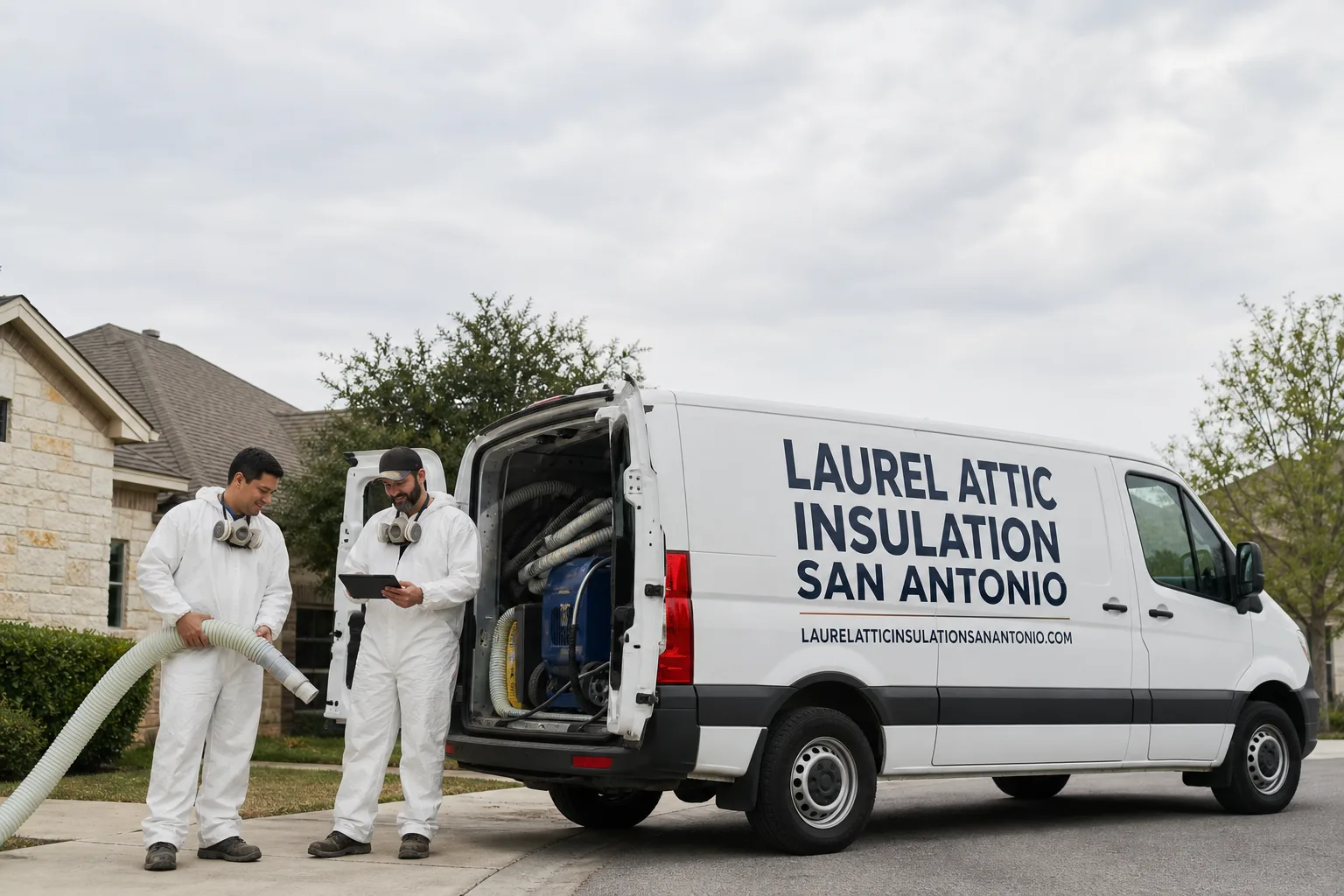
How Much Does Radiant Barrier Installation Cost in San Antonio?
Radiant barrier installation in San Antonio typically costs $1,200 to $3,800 for a standard single-story home, with most homeowners paying around $2,200 for materials and labor combined. The price per square foot ranges from $0.90 to $3.20 depending on whether you choose a foil-faced product stapled to rafters or a spray-applied barrier. Our team at Laurel Attic Insulation San Antonio provides a written price before any work starts, so the number you see is the number you pay.
If you want the short version: radiant barriers reflect heat away from your attic, cutting down on how hard your AC works during San Antonio’s brutal summers. The cost depends on your attic’s square footage, roof pitch, existing insulation condition, and whether you go with a foil or spray-on product.
Radiant Barrier Installation Cost Breakdown (2026)
Here’s what radiant barrier installation actually costs in the San Antonio metro area right now. These numbers come from jobs we’ve quoted and completed across the city this year, from Alamo Heights to Helotes to Converse.
| Item | Cost Range | Notes |
|---|---|---|
| Foil radiant barrier (materials only) | $0.15 – $0.45 per sq ft | Reinforced foil, typically 48″ wide rolls |
| Spray-applied radiant barrier (materials only) | $0.40 – $0.75 per sq ft | Applied to attic ceiling deck |
| Labor for foil installation | $0.75 – $1.50 per sq ft | Stapling to rafters in existing home |
| Labor for spray application | $0.50 – $0.90 per sq ft | Includes masking and cleanup |
| Typical 1,500 sq ft attic, foil system | $1,350 – $2,925 | Full install, materials and labor |
| Typical 1,500 sq ft attic, spray system | $1,350 – $2,475 | Full install, materials and labor |
| Attic prep and cleanup | $100 – $300 | Clearing debris, minor repairs |
| Insulation top-up (if recommended) | $400 – $1,200 | Blown-in fiberglass or cellulose |
Several things move that number up or down. A two-story home with a complex roof line costs more because technicians spend more time navigating valleys, hips, and tight corners. If your attic has old batt insulation that needs pulling or if there’s rodent damage, prep work adds $150 to $500. Homes in newer developments like Alamo Ranch or Cibolo Canyon tend to have cleaner, more open attics, which keeps labor on the lower end. Older homes in Monte Vista or Jefferson with steep pitches and original framing often run toward the top of the range.
Chase Whitaker, who leads our San Antonio team, puts it this way: a radiant barrier is one of the few home improvements where the product cost is modest but the labor and attention to detail make the difference. A poorly installed barrier with sagging foil and gaps at the seams gives you maybe 30 percent of the benefit. Done right, it reflects up to 95 percent of radiant heat.
What Affects Radiant Barrier Installation Pricing in San Antonio
Here are the factors that actually move your price, based on what we see week to week across Bexar County.
- Your attic’s square footage. This is the baseline. More deck surface to cover means more material and more time. A 1,000-square-foot ranch in Harlandale runs less than a 3,400-square-foot two-story in Stone Oak.
- Roof pitch and attic accessibility. Steep roofs and attics with low clearance slow work down. If a technician can’t stand upright in parts of the attic, expect labor to rise 15 to 25 percent.
- Product type: foil vs. spray-applied. Foil costs less per square foot but takes more labor to staple properly. Spray barriers apply faster but require masking and ventilation, and they cost more per square foot for material.
- Existing insulation condition. If your blown-in insulation is compressed, wet, or full of pest droppings, that has to be handled first. In San Antonio, where humidity and roof rats are both common, we see insulation replacement or topping as part of roughly one in three radiant barrier jobs.
- Ductwork layout. If your HVAC ducts run through the attic and sit close to the ceiling deck, technicians have to work around them. In some San Antonio homes built before 2000, ducts hang low and make installation noticeably slower.
- Seasonal demand. Late spring and early summer are peak. Prices don’t swing wildly, but scheduling becomes tighter, and some contractors add a 5 to 10 percent peak-season premium in May and June. We don’t.
Is Radiant Barrier Worth It in San Antonio?
The short answer: for most San Antonio homeowners, yes. This city sees 100-plus degree days every summer, and your attic is where the heat accumulates first. Attic temperatures in San Antonio regularly hit 140 to 160 degrees in July and August even when the outside air is 100. A radiant barrier drops attic temps by 20 to 30 degrees on a hot afternoon.
What that means for your utility bill depends on your home. A 2010 study by the Florida Solar Energy Center (the most-cited data in the industry) showed radiant barriers reduce cooling costs by 8 to 12 percent in hot climates. In San Antonio terms, if you’re paying CPS Energy $220 a month for electricity during the summer, a radiant barrier could shave $18 to $26 off each summer bill. Over the five-month cooling season, that’s $90 to $130 a year. At a $2,200 install cost, you’re looking at a payback period of roughly 8 to 12 years through energy savings alone. If you add in the comfort difference and reduced wear on your HVAC system, most homeowners in our market tell us they’d do it again.
One honest note: if your attic already has R-38 or better insulation and sealed air leaks, a radiant barrier still helps but less than for a home with older, thinner insulation. That’s why we always check what’s already up there before recommending anything. If you’re considering radiant barrier, you can start with our main Radiant Barrier Installation in San Antonio page for service details.
Foil Radiant Barrier vs. Spray-On Radiant Barrier: Cost and Performance
You’ll meet both products in any serious San Antonio quote. Here’s how they compare in our market.
Foil radiant barrier is a reinforced aluminum sheet, usually perforated to allow moisture to pass through. It gets stapled to the underside of your roof decking with the shiny side facing down into the attic. Material runs $0.15 to $0.45 per square foot, and labor takes a full day on a typical home. The perforated version is the right call for San Antonio’s humidity; it lets water vapor escape rather than trapping condensation against the roof deck. Expect a foil system on a 1,500-square-foot attic to run $1,350 to $2,925 installed. It’s durable when installed correctly, but it does collect dust over time. Dust reduces reflectivity, which is why some homeowners in dusty areas near Loop 1604 construction zones or gravel roads benefit from a quick inspection every few years.
Spray-applied radiant barrier is a low-emissivity paint with aluminum flake that gets sprayed directly onto the attic ceiling deck. Material costs $0.40 to $0.75 per square foot, and while application is faster than stapling foil, it requires masking any areas you don’t want coated. A 1,500-square-foot attic runs $1,350 to $2,475 installed. The advantage: spray barrier conforms to any roof shape and reaches tight spots where foil can’t be stapled. The disadvantage: it can’t be perforated, so proper attic ventilation matters more, and it’s more difficult to remove if you ever need to re-roof.
For most San Antonio homes with traditional shingle roofs, we spec a perforated foil system. It delivers better reflectivity per dollar and holds up well in our climate. For homes with unusual roof geometry or areas where staples won’t hold, a spray barrier fills the gap.
Radiant Barrier and Your Existing Insulation: What to Check First
Radiant barrier and insulation do different jobs. Insulation slows conductive heat transfer; radiant barrier reflects radiant heat. They work together. In a San Antonio attic, the best combination is R-30 to R-38 blown-in insulation on the attic floor plus a radiant barrier on the roof deck.
If your attic insulation is thin, old, or compressed below R-19, installing a radiant barrier without topping up insulation is a half measure. You’ll still feel the heat radiating down from the deck, but you’ll also lose cool air through the ceiling because there’s not enough resistance. When we inspect attics for radiant barrier installation, we measure insulation depth and check for voids. We’ve seen homes in older San Antonio neighborhoods like Highland Park and Beacon Hill with R-11 batts from the 1960s. In those cases, we recommend adding blown-in insulation at $400 to $1,200 depending on square footage before or alongside the barrier install.
How to Save on Radiant Barrier Installation
There are real ways to move your cost down without cutting corners. Here’s what works in San Antonio.
- Get a detailed written quote before you commit. A real quote lists material type, square footage, labor, and prep separately. If a contractor says “around $2,500” and won’t put it in writing, walk. Our quotes are itemized and delivered in writing before any work begins.
- Bundle with insulation work. If you need blown-in insulation topped up, doing it the same day as the radiant barrier saves on trip fees and prep time. You pay once for the crew to be there, mask, and clean up.
- Schedule in fall or winter. Demand drops in October through February. You’ll have more scheduling flexibility and can take your time making a decision without heat pressure.
- Check for CPS Energy rebates. CPS Energy has run periodic rebate programs for energy-efficiency upgrades. As of 2026, some attic insulation and radiant barrier projects qualify for $0.25 to $0.40 per square foot in rebates through approved contractors. We can check current eligibility during a free estimate.
- Handle attic prep yourself if you’re able. Clearing stored items, boxes, and old holiday decorations out of the attic before we arrive saves prep labor. If we have to move and work around your stuff, that adds time.
For a free, no-pressure estimate with a written price, call (254) 279-0971. The estimate takes about 45 minutes and includes an attic inspection with photos.
Radiant Barrier Installation Cost: San Antonio Neighborhood Examples
Every neighborhood has its own typical attic profile. Here’s what we see across the city.
Alamo Heights and Terrell Hills: Older homes from the 1940s and 50s with steep gable roofs, original framing, and sometimes knob-and-tube wiring to work around. Attic access is often a narrow pull-down stair. Radiant barrier installs here run $1,800 to $3,800 due to complexity and clearance issues. Some homes have already had insulation retrofit, which helps.
Stone Oak and Encino Park: Newer construction from the 1990s and 2000s with open attics, trusses, and good access. These are straightforward jobs. Expect $1,200 to $2,400 for a typical home. Spray barriers are popular in this area because the attics are large and deck space is open.
Monte Vista and Olmos Park: Historic homes with challenging roof lines, multiple gables, and attics that often contain old ductwork and wiring. Radiant barrier installation costs $2,000 to $4,000. Prep work is almost always needed because attic floors are often used for storage and old insulation needs careful handling.
Alamo Ranch and Westover Hills: Large single-story homes with big attic footprints, usually 2,000 to 3,500 square feet. Total project costs run $1,800 to $3,500. The roof decks are typically clean OSB, which staples well. These homes benefit most from radiant barrier because the sun exposure in far west San Antonio is relentless.
King William and Southtown: A mix of restored and partially updated homes. Attics are often tight with flat or low-slope roof sections. Where slope exists, foil works; where it’s flat, we often recommend reinforcing insulation instead. Radiant barrier on the sloped sections runs $1,500 to $3,000. Flat sections can’t accept a radiant barrier, and a good contractor will tell you that rather than selling you something that won’t work.
How the Installation Process Works (and Why It Matters for Pricing)
Understanding what happens on install day helps you understand the price.
Step 1: Attic inspection and measurement. We measure the deck surface area, check insulation depth, note ductwork and electrical, and look for venting problems. This happens during the free estimate. In San Antonio, where summer attic temperatures can reach 150 degrees, we also check whether your attic has sufficient ventilation – radiant barrier works best in a vented attic.
Step 2: Prep. If insulation needs topping, old material needs removing, or obstructions need clearing, that’s handled first. In most San Antonio homes, prep takes 1 to 3 hours.
Step 3: Installation. For foil, technicians staple the barrier to the underside of the roof deck with a 1-inch overlap at seams. For spray, they mask and apply the coating in a single pass. A typical 1,500-square-foot attic takes 4 to 7 hours for foil, 3 to 5 hours for spray.
Step 4: Inspection and photos. Before we leave, we photograph the entire installation and review it with you. Every Laurel Attic Insulation job includes before-and-after photo proof, delivered with your invoice. You can pay from the link in the invoice.
The Relay Visibility Guarantee means you see a live technician arrival time, get photo updates, and receive a written price before anything starts. That’s the standard on every job, including radiant barrier installation. And if something isn’t right within 365 days, our Done Right Promise covers it. If a repair fails, the second visit is free. No charge, no argument.
How Much Does Radiant Barrier Save on CPS Energy Bills in San Antonio?
The most honest answer: you’ll likely save 5 to 12 percent on summer cooling costs, with the higher end applying to homes with older insulation and single-pane windows. Let’s put dollars on it.
If your home is 1,800 square feet and you run your AC hard from May through September, your CPS Energy bill in summer might average $250 a month. A 10 percent cooling reduction saves about $25 a month during peak season, or $125 over the five hot months. If you also run your AC in shoulder months like April and October, add another $15 to $25 a year. Total realistic annual savings: $130 to $180.
At a $2,200 installation cost, your simple payback is 12 to 17 years based on energy alone. That’s honest math. Where radiant barrier earns its keep faster is in comfort: your upstairs rooms and the rooms under a west-facing roof stay measurably cooler, and your AC cycles less, which extends equipment life. Some CPS Energy customers report more dramatic savings when they combine radiant barrier with attic insulation top-up and air sealing. A full attic energy package typically saves 15 to 25 percent on cooling.
Common Mistakes That Make Radiant Barrier Less Effective
Radiant barrier works only if it’s installed correctly. Here’s what we fix most often when we follow other contractors.
- Stapling to the attic floor instead of the roof deck. A barrier lying on top of insulation collects dust fast and reflects almost nothing. It has to go on the underside of the roof deck to work. In some San Antonio homes we’ve seen foil laid flat on the insulation, which is a complete waste of money.
- Skipping the air gap. Radiant barrier needs an air space on at least one side to reflect heat. When foil is sandwiched directly against the roof deck with no gap, it conducts heat instead of reflecting it. Proper installation leaves a 3/4-inch minimum air gap between the foil and the deck.
- Using non-perforated foil in a humid attic. San Antonio’s humidity is real. Non-perforated foil can trap moisture against the roof deck, leading to mold and sheathing rot. Always use perforated foil unless the attic has exceptional ventilation.
- Covering soffit vents. Some installers run foil right over the soffit vents, blocking intake airflow. That turns a vented attic into a sealed, super-heated box. Your soffits must stay clear.
- Not addressing insulation first. A radiant barrier over R-11 insulation still leaves you with an underperforming attic. The barrier reflects radiant heat, but conduction losses through thin insulation continue.
Our installers are trained on these details on every job. It’s why we photograph everything and walk you through the install before we leave.
Do You Need a Permit for Radiant Barrier Installation in San Antonio?
Radiant barrier installation in an existing home does not require a building permit in San Antonio or unincorporated Bexar County. It’s classified as a non-structural insulation improvement. That saves you $150 to $400 in permit fees compared to projects like re-roofing or adding a room.
If you’re in a historic district like Monte Vista or King William, check with your HOA or the city’s Office of Historic Preservation before any attic work that might be visible from the street. Radiant barrier is interior work, so it’s almost never restricted, but it’s a two-minute phone call that avoids a headache.
New construction is different. If your home is being built, radiant barrier is installed by the builder before the roof deck is closed. In that case, it’s part of the construction permit and you don’t pay for it separately.
Radiant Barrier vs. Alternative Attic Upgrades: Cost Comparison
Radiant barrier isn’t the only way to cool an attic. Here’s how it stacks against alternatives in the San Antonio market.
- Blown-in fiberglass insulation top-up (R-30 to R-38): $900 to $2,100 for a 1,500-square-foot attic. Best first step if your insulation is thin. Reduces both heat gain and heat loss year-round.
- Blown-in cellulose insulation (R-30 to R-38): $1,100 to $2,400 for the same attic. Slightly better air-sealing properties than fiberglass.
- Spray foam insulation on the roof deck (open-cell): $2,800 to $6,500 for a typical San Antonio attic. Turns your attic into a conditioned space, eliminating the need for a radiant barrier entirely. More expensive but more comprehensive.
- Attic ventilation improvement (solar attic fan or ridge vents): $500 to $1,800. Works alongside a radiant barrier by moving hot air out. In San Antonio, a powered attic ventilator can drop attic temps another 10 to 15 degrees.
- Radiant barrier: $1,200 to $3,800. Most cost-effective per dollar for summer heat reduction alone.
In our market, the most common combo is a blown-in insulation top-up plus a perforated foil radiant barrier. Total cost for a 1,500-square-foot attic: $2,000 to $4,500. That’s the package that moves the needle most for San Antonio summers.
How to Choose a Radiant Barrier Installer in San Antonio
Here’s what to ask any contractor before you sign.
- “Will you put the price in writing before work starts?” If the answer is anything but yes, move on. Every Laurel Attic Insulation job includes a written price delivered before anything starts. No door-step surprises.
- “What product are you installing, and is it perforated?” For foil, you want perforated. For spray, ask about emissivity ratings. A quality spray barrier has an emissivity of 0.25 or lower.
- “Will I get photos of the finished work?” If you can’t get into your attic easily, photos are the only way to verify the job. We deliver before-and-after photos on every job, automatically.
- “What’s your warranty in writing?” Look for at least one year of workmanship coverage. Our 365-Day Done Right Promise covers workmanship for a full year. If the repair fails, the second visit is free.
- “Can I reach a live person after hours?” If your attic develops an issue at 9pm in July, you don’t want voicemail. Our phone is answered by a live person 24/7.
Chase Whitaker has led our San Antonio radiant barrier and insulation team since 2003. His crew installs using materials from Owens Corning, Johns Manville, Knauf, Rockwool, CertainTeed, Icynene, Demilec, and GreenFiber. We match the material to the job, not to whatever happens to be on the truck.
FAQs – Radiant Barrier Installation Cost
How much does radiant barrier installation cost per square foot in San Antonio?
Radiant barrier installation in San Antonio runs $0.90 to $3.20 per square foot for a full installed system. Foil barriers on the roof deck typically cost $0.90 to $1.95 per square foot installed, while spray-applied barriers run $0.90 to $1.65 per square foot installed. For an exact number on your attic, call (254) 279-0971 and we’ll give you a written estimate for free.
Is radiant barrier worth the cost in San Antonio?
For most San Antonio homes, yes. At an average installed cost of $2,200, a radiant barrier saves roughly $130 to $180 per year on cooling, and attic temperatures drop 20 to 30 degrees on summer afternoons. If your attic currently has less than R-19 insulation, pair the barrier with an insulation top-up for the best return. We can check your attic and tell you honestly whether it’s worth it for your specific home.
Can you install radiant barrier in an existing home?
Yes. Radiant barrier is routinely installed in existing San Antonio homes by stapling perforated foil to the underside of the roof deck or spraying a low-e coating on the deck. A typical 1,500-square-foot attic takes one day. No permit is required for existing homes in San Antonio. Call (254) 279-0971 to schedule a free attic inspection and written estimate.
How long does radiant barrier installation take?
A standard San Antonio home with a 1,500-square-foot attic takes 4 to 7 hours for foil installation or 3 to 5 hours for spray application. Prep work like clearing debris or topping up insulation adds 1 to 3 hours. Most installs are completed in a single day. We arrive at a live, trackable time, not a four-hour window.
Does radiant barrier work in winter or does it only help in summer?
Radiant barrier helps most in summer because it reflects heat away from your attic before it can radiate into your living space. In winter, it provides a smaller benefit by reflecting heat from your living space back down, but the effect is minor. In San Antonio, the cooling season dominates, so radiant barrier is a summer-first investment. If you want year-round improvement, combine it with an insulation top-up, which helps in both seasons.
Can I install radiant barrier myself to save money?
You can buy foil radiant barrier at most San Antonio home improvement stores for $0.15 to $0.45 per square foot, and DIY installation saves labor. But attic work in July is genuinely dangerous. San Antonio attic temperatures reach 140 to 150 degrees, which can cause heat exhaustion fast, and working on roof trusses above your living space carries real fall risk. Improperly installed foil with no air gap or blocked soffit vents delivers almost no benefit. We recommend a trained professional for this work, and our estimates are free, so you can compare the numbers before deciding.
Get a Free Radiant Barrier Installation Estimate in San Antonio
If you’re considering a radiant barrier for your San Antonio home, the next step is simple. Call (254) 279-0971 to schedule a free attic inspection and written estimate. We’ll measure your attic, check your existing insulation, and give you a line-item price for foil or spray-applied radiant barrier. No pressure, no vague “around $2,500” estimates, and no surprises at the door. You’ll get a written price before anything starts, a live arrival time, and before-and-after photos of the finished job. That’s the Relay Standard on every job, and it’s been our way since 2003.
Written by Chase Whitaker, Owner at Laurel Attic Insulation San Antonio, serving San Antonio since 2003.
Pricing reflects the San Antonio market as of 2026. Laurel Attic Insulation San Antonio offers free estimates – call (254) 279-0971.
What Our Customers Say
"Utility bill dropped the next month. Our summer electric bill was lower by a visible amount."
- Gary J."Quote in the app was clear on R-value and price."
- Doris L."Easy to book and easy to pay. The invoice came by text and I paid it from the driveway."
- Rudy B.