
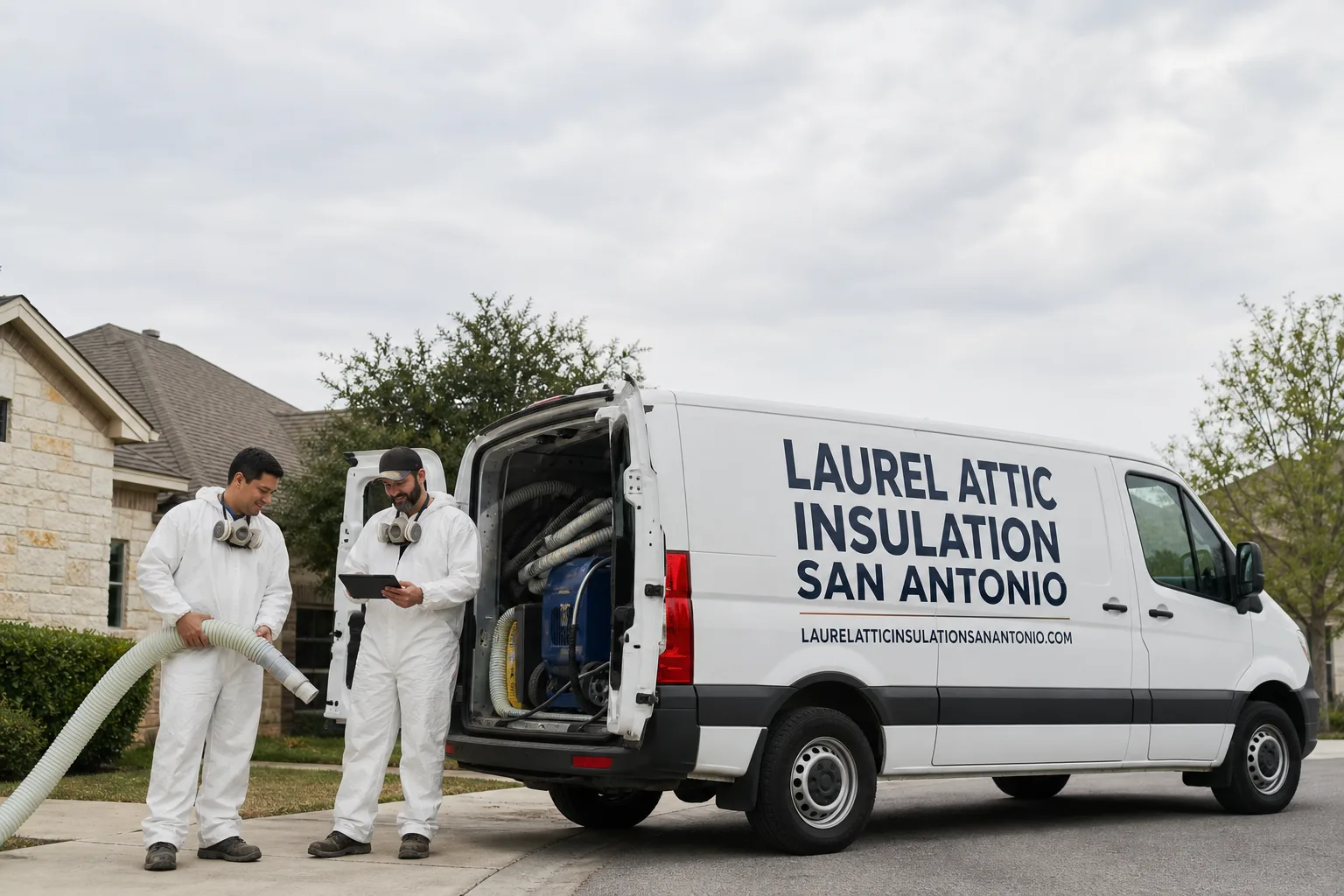
Fast, Reliable Attic Insulation Across Castle Hills
Attic insulation in Castle Hills usually means one of two jobs: topping up settled fiberglass that’s decades old, or replacing vermiculite that may need an asbestos check before anyone touches it. Most projects run $900 – $2,400 depending on square footage and the R-value required. We dispatch crews to Castle Hills neighborhoods daily, often same-week, and you’ll get a written price before any work starts. Call (254) 279-0971 to schedule a free attic inspection.
We know Castle Hills homes. The 1950s – 1970s brick ranches along streets like Bridle Path and Hitching Post have a specific set of attic problems that newer subdivisions simply don’t. That local knowledge changes how we quote, what we inspect first, and which materials we recommend. Our Attic Insulation team works these attics regularly, and we’ve seen what Texas humidity does to insulation that’s been up there since Eisenhower was in office.
Why Laurel Attic Insulation San Antonio Is Castle Hills’s Preferred Attic Insulation Company
Castle Hills homeowners call us because we show up when we say we will, with a written price in hand. The Relay Visibility Guarantee means you get live arrival tracking, before-and-after photos of the attic, and a digital invoice you can pay from a link. No vague four-hour windows. If you book with us, you’ll know exactly when our crew is pulling onto your street.
Chase Whitaker leads our team, and he’s built the operation around one rule: put everything in writing. Every Castle Hills job includes a written guarantee and a 365-Day Done Right Promise. If the work isn’t right, we come back and make it right. Free second visit if a repair fails. No charge, no argument. That’s the standard, and it’s printed on every invoice.
We answer the phone 24/7. A live person. When you call about attic insulation in Castle Hills, you’re not leaving a voicemail and hoping someone calls back before the next heat wave. You get a real human, a straight answer, and a scheduled inspection time that works around your day.
Attic Ventilation in Castle Hills
Attic ventilation in Castle Hills is often the missing piece when a 1960s ranch won’t cool evenly. The original builders ran soffit vents sparingly or not at all. We see it on nearly every block: sealed soffits, a couple of passive roof vents, and attic air that hits 140°F by mid-afternoon. The fix involves air-sealing the attic floor first, then installing baffles at the eaves and balancing intake and exhaust so humid air doesn’t sit against the rafters.
A ventilation correction in Castle Hills typically runs $400 – $1,100 depending on how many soffit bays need baffles and whether we’re adding a powered or solar exhaust vent. It’s not glamorous work. But it’s the difference between mold on the rafters and an attic that actually breathes.
Baffle Installation and Soffit Repair
Most Castle Hills ranches have aluminum or vinyl soffits that were never cut for airflow. We open the bays, install foam or plastic baffles, and confirm the insulation isn’t blocking the intake path. This also protects blown-in fiberglass from drifting into the soffit and getting damp.
Exhaust Vent Sizing
Too many Castle Hills attics have one undersized box vent for 1,800 square feet of roof. We calculate intake-to-exhaust ratio and add ridge or turbine vents where needed. Correct airflow extends shingle life and keeps ceiling temperatures down in August.
Radiant Barrier in Castle Hills
A radiant barrier in Castle Hills is one of the highest-return upgrades for a 1960s ranch with dark shingles and west-facing roof planes. The material is a foil facing stapled to the underside of the roof deck. It reflects radiant heat back out of the attic before it ever reaches your insulation. In a Castle Hills summer, that can drop attic temperatures by 20 – 30 degrees.
Radiant barrier installation in Castle Hills runs $1,200 – $2,800 for a typical single-story home, depending on roofline complexity and whether we’re working around existing ductwork. It works alongside fiberglass batts or blown-in insulation, not instead of them. Think of it as a heat shield. Your insulation still does the heavy lifting; the radiant barrier just stops the sun from cooking the attic in the first place.
Stapled Foil vs. Spray-Applied
We prefer stapled foil for Castle Hills attics with standard truss framing. It’s cleaner than spray-applied radiant coatings and easier to inspect later. For low-slope or complicated roof geometry, we’ll recommend the spray option and show you exact coverage photos when we’re done.
When Radiant Barrier Makes Sense
If your upstairs bedrooms run 5 – 8 degrees warmer than the rest of the house in July, a radiant barrier is likely part of the answer. We pair it with air sealing and insulation top-up so you’re not solving one problem and leaving two others untouched.
Trusted Brands We Service in Castle Hills
Our crews work with materials from Owens Corning, Demilec, and GreenFiber, matched to the job rather than whatever’s on the truck. For a Castle Hills ranch with settled original batts, that usually means Owens Corning ProPink blown-in fiberglass to R-38. For new construction or a full remodel, we may spec Demilec open-cell spray foam. We keep common sizes stocked for Castle Hills projects, which means shorter lead times and fewer rescheduled install days. When you book, we’ll tell you exactly which brand and product we’re installing and why.
Common Attic Insulation Problems We See in Castle Hills Homes
- Settled original fiberglass or mineral wool. Many Castle Hills attics measure R-19 or less at the floor because the 1960s-era batts have compressed to a fraction of their original thickness. That means ceiling temperatures spike by mid-afternoon and cooling bills climb through July and August.
- Unvented soffits trapping humid air. Castle Hills ranch homes often have zero soffit airflow. Without baffles and intake vents, humid air stalls against the roof deck and you get mold on the rafters plus saturated insulation that loses R-value fast.
- Unsealed penetrations around recessed lights and bath fans. We find gaps around light cans and fan housings on nearly every inspection. Conditioned air gets pulled into the attic, and dust settles into the insulation over time, reducing its performance.
- Original vermiculite from the 1950s – 1960s. Some Castle Hills attics still contain zonolite vermiculite, which may carry asbestos contamination. Any re-insulation job should start with a check before we disturb the attic floor. We’ll flag it during inspection and coordinate testing before any removal work proceeds.
Pricing for Attic Insulation in Castle Hills, TX
Most attic insulation jobs in Castle Hills run $900 – $2,400. A straightforward top-up of blown-in fiberglass in a 1,400-square-foot ranch is on the lower end. A full replacement with air sealing, baffle installation, and a radiant barrier package lands higher. Vermiculite removal, if testing confirms asbestos, is a separate line item we coordinate with a licensed abatement company. You’ll get the full written price before work starts, every time. Call (254) 279-0971 for a free Castle Hills attic inspection and an exact quote based on your square footage and current R-value.
We Also Serve Cities Near Castle Hills
Beyond Castle Hills, our crews cover Attic Insulation in Castle Hills and the surrounding corridor including San Antonio, Selma, Converse, and Leon Valley. If you’re just outside Castle Hills and need attic insulation, call us and we’ll confirm next-available scheduling for your area.
Serving Castle Hills, TX - Our Local Coverage Area
We’re based in the Castle Hills area and know this community well. Use the map below to see our service coverage - if you’re nearby, we can almost certainly help.
FAQs About Attic Insulation in Castle Hills
Look for small, pebble-like gray-gold granules scattered across the attic floor. If your home was built between 1950 and 1980 in Castle Hills, there’s a real chance it’s zonolite vermiculite. Don’t disturb it. Call us for an inspection, and we’ll arrange asbestos testing before any insulation work begins. Call (254) 279-0971 and we’ll walk you through what we see in a typical Castle Hills attic.
Builders in the 1950s – 1970s often sealed soffits entirely or relied on tiny gable vents that moved almost no air. That traps moisture against the rafters and degrades insulation performance. We correct it with baffles, soffit cuts, and balanced exhaust venting before adding new insulation.
Radiant barrier is an add-on, not a replacement. If your batts are in good shape and the attic still gets punishingly hot, a foil radiant barrier under the roof deck will cut radiant heat gain and make the whole system work better. It’s one of the most common combos we install in Castle Hills.
Sometimes yes. We often find sloped ceiling cavities in split-levels with nearly no insulation, plus unsealed top plates pulling conditioned air into the attic. In a recent Bridle Path job, air sealing plus R-38 blown-in fiberglass and a radiant barrier held an upstairs bedroom at 72°F on a 98°F July afternoon. Call for an inspection and we’ll map exactly what’s going on in your attic.
For our climate, we recommend R-38 to R-49 in the attic floor, which is what the current energy codes call for in this region. Castle Hills follows Texas’s adopted energy code standards. We’ll confirm your current R-value during inspection and quote the top-up needed to hit the right number. Call (254) 279-0971 for a free estimate.
Written by Chase Whitaker, Owner at Laurel Attic Insulation San Antonio, serving Castle Hills with written pricing, photo proof of every job, and the Relay Visibility Guarantee.