
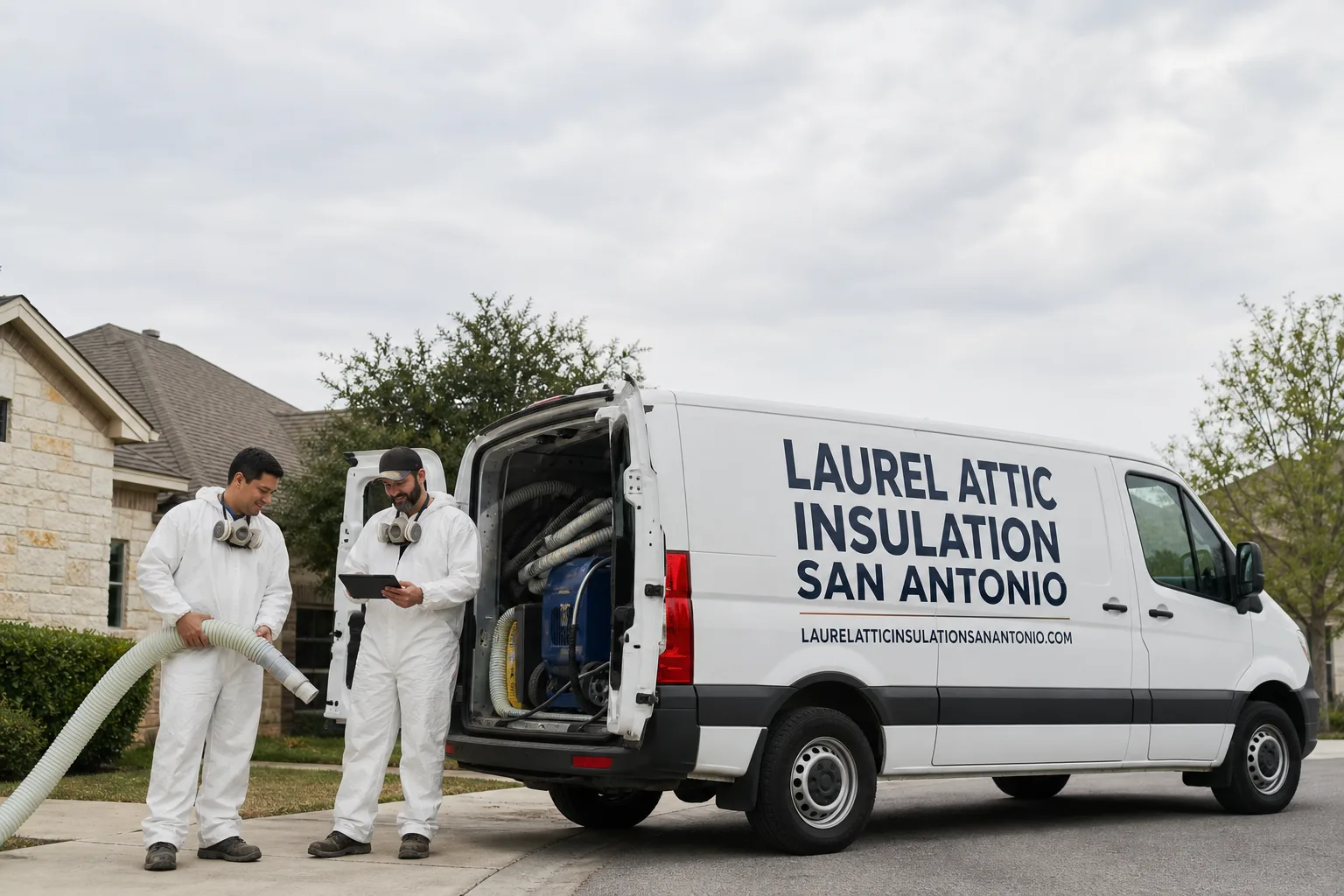
Fast, Reliable Attic Insulation Across Converse
Attic insulation in Converse usually costs between $900 and $2,400 for a typical single-family home, depending on square footage, existing material condition, and the R-value your attic actually needs. Most jobs are finished in one day. If your ranch home east of FM 1976 still has original insulation from the Kennedy administration, you’re paying more to cool it than you should be. Call Laurel Attic Insulation at (254) 279-0971 and we’ll give you a written price before anything starts.
Key Takeaways
- Typical cost in Converse: $900 – $2,400 for full attic insulation, with top-ups running $600 – $1,200.
- The biggest local problem: compacted blown-in cellulose in 1950s-70s ranches that reads as AC trouble but is actually insulation failure.
- Radiant barriers pay off here: South Texas attic heat makes them one of the highest-ROI upgrades in Converse, not a gimmick.
- One-trip retrofit approach: we remove degraded material, air-seal, insulate to R-38, and add ventilation or radiant barrier in a single visit.
- Every job includes: a written price upfront, live arrival tracking, before-and-after photos, and a 365-Day Done Right Promise in writing.
Why Laurel Attic Insulation San Antonio Is Converse’s Preferred Attic Insulation Company
Converse homeowners call us because we show up when we say we will, and we put the price in writing before the blower hose comes off the truck. Our crews know the difference between a 1962 ranch off Schaefer Road and a 2005 build near Northampton, and we spec the R-value and material to match, not to whatever is left on the shelf. Chase Whitaker runs our operation with a simple rule: if it’s not documented, it didn’t happen. That’s why you get photo proof of the attic after we finish, not just a bill.
We’re part of the Relay Home Co. family, which means one thing you’ll notice immediately. Book in a tap, get a live arrival time, receive before-and-after photos, pay from the link. No four-hour windows. No wondering who’s pulling up. Our background-checked, uniformed technicians serve Converse from our San Antonio office, and most calls in Converse get same-week scheduling. If your attic is an emergency, someone answers our phone 24/7. A live person, not a callback queue.
Attic Ventilation in Converse
Attic ventilation in Converse is the difference between an attic that bakes at 140°F and one that breathes. The hot, humid South Texas climate puts enormous heat and moisture load on your roof deck. Without proper intake and exhaust airflow, that moisture condenses on sheathing, feeds mold, and curls shingles years before their time. In Converse, undersized ventilation is one of the three most common attic failures we correct alongside insulation work.
How We Fix Undersized Airflow
We inspect your current soffit vents, ridge vents, and any powered fans. Then we calculate the net free vent area your attic’s square footage demands. Most older Converse ranches have about half the airflow they should. We replace blocked or undersized vents, add baffles at the eaves so insulation doesn’t choke the intake, and balance exhaust at the ridge.
Adding Baffles to Keep Insulation From Blocking Air
Blown-in insulation without baffles eventually piles over soffit vents and starves the attic. Each baffle costs a few dollars, but the labor to retro-fit them correctly matters. We include baffle installation as part of any full insulation replacement in Converse homes where soffit venting is compromised.
Radiant Barrier in Converse
Radiant barrier in Converse is one of the smartest single upgrades for a mid-century ranch. It’s a reflective foil attached to the underside of the roof deck that reflects radiant heat back out instead of letting the attic soak it up. In Converse’s July heat, an unventilated attic can hit 150°F before noon. A radiant barrier can drop that by 20°F or more, which directly cuts the load on your AC and keeps ceiling temperatures even across the house.
When a Radiant Barrier Makes Sense Here
If your attic already has decent insulation but the house still feels hot at night, radiant heat is the culprit. That’s common in Converse homes with dark shingles and limited tree cover. We recommend radiant barrier on most homes east of FM 1976 where attic temperatures run highest and cooling bills climb from May through October.
Radiant Barrier Vs. More Insulation
The two solve different problems. Insulation slows conductive heat moving down through your ceiling. Radiant barrier reflects the sun’s radiant load before it ever reaches that insulation. In Converse, the best results usually come from pairing them: air-seal, insulate to R-38, then add radiant barrier to the roof deck. One trip, all three done.
Trusted Brands We Service in Converse
We install and service insulation from Owens Corning, GreenFiber, and Demilec, including Converse Reflectix service, matching material to the job rather than what happens to be on the truck. For a 1960s Converse ranch, GreenFiber blown-in cellulose often makes the most sense. It fills odd joist bays and settles into the gaps older homes always have. For open attics in newer subdivisions, Owens Corning fiberglass batts or Demilec spray foam deliver clean, consistent R-value. We keep common materials stocked for Converse jobs, which means faster turnaround and fewer rescheduled appointments.
Common Attic Insulation Problems We See in Converse Homes
- Compacted cellulose under intense attic heat. Blown-in cellulose in older Converse homes can settle from R-30 down to R-19 or worse. The symptom is hot spots on ceilings that homeowners mistake for AC failure.
- Zero air sealing at top plates and recessed lights. Original 1960s and 70s construction has gaping holes where the wall meets the attic. Conditioned air pours into the attic, and humid outdoor air gets pulled into the house.
- Undersized attic ventilation and moisture damage. The humidity here means any airflow shortfall turns into mold on roof sheathing, rusted nails, and warped decking. We find this on nearly every pre-1980 home we open up.
- Original single-pane windows compounding insulation loss. Attic insulation can’t fix windows, but a tight attic envelope reduces the negative pressure that pulls hot air in through old windows. Upgrade the attic and the whole house performs better.
Our crew recently serviced a 1960s ranch off Schafer Road. The homeowner called about ceiling hot spots they were convinced meant a failing AC. In the attic, we found blown-in cellulose that had compacted to less than R-19 under years of intense South Texas heat. We handled the Insulation Removal - Converse job first, then air-sealed the top plates and recessed can lights, and blew in GreenFiber cellulose to R-38, then added a radiant barrier. One trip, no more hot spots, and the AC cycled normally again.
Pricing for Attic Insulation in Converse, TX
Here’s what Converse homeowners can expect. A straightforward attic insulation top-up over existing material runs $600 to $1,200. Full removal of degraded insulation, air sealing, and new blown-in insulation to R-38 typically lands between $1,500 and $2,400 for a standard 1,200 to 1,800 square foot ranch. Adding a radiant barrier is usually a $0.50 to $0.80 per square foot line item. Attic ventilation corrections, including new baffles or ridge vent, add $400 to $900 depending on what’s already there. The two things that move the number most: attic accessibility and how much old material has to come out before we start. We give you a written price before any work begins, with no door-step changes. Call (254) 279-0971 for a free estimate.
We Also Serve Cities Near Converse
Our crews work throughout Converse and the surrounding northeast San Antonio metro. We regularly run jobs in Universal City, where the housing stock mirrors much of Converse’s mid-century construction, and throughout San Antonio proper. If you’re a few minutes outside Converse and your attic is struggling with the same heat and humidity, call us and we’ll get you on the schedule.
Serving Converse, TX - Our Local Coverage Area
We’re based in the Converse area and know this community well. Use the map below to see our service coverage - if you’re nearby, we can almost certainly help.
FAQs About Attic Insulation in Converse
Because the top plates, wire penetrations, and recessed can lights in 1950s-70s ranch construction were never sealed, so conditioned air escapes into the attic while humid outdoor air gets drawn into the house. Blowing insulation over those gaps doesn’t stop the air leak. Air sealing first means the new insulation actually does its job. Call (254) 279-0971 and we’ll inspect your attic and tell you exactly what’s leaking.
Blown-in cellulose compacts faster under Converse’s sustained high attic temperatures, especially when attic ventilation is undersized. After 15 to 20 years, material that started at R-30 can test below R-19. The moisture from humidity accelerates degradation too. That’s why we recommend an attic inspection every few years on pre-1990 Converse homes, even if the insulation looked fine last decade.
R-38 is the right target for Converse’s climate zone, which is what we blow or batt on nearly every full retrofit. A radiant barrier is a separate layer that reflects heat before it reaches the insulation. In Converse’s long cooling season, most older homes benefit from both, especially if the roof has dark shingles and the attic is unventilated or barely ventilated. We’ll give you a written recommendation based on your specific roof and attic layout.
Yes. When we air-seal, insulate to R-38, and add a radiant barrier, the temperature difference between rooms narrows dramatically. Hot spots usually come from compacted insulation, missing material over a particular joist bay, or unsealed recessed lights. We fix the cause, not the symptom. Call (254) 279-0971 for an attic inspection and a written price.
Sometimes, but not always. If the old batts are dry, intact, and still in place, we can blow new material right over them after air sealing. If they’re water-damaged, moldy, or have rodent activity, removal makes sense before new insulation goes in. We’ll show you photos from the attic so you can see what we’re seeing, then you decide. No pressure, just the facts.
Written by Chase Whitaker, Owner at Laurel Attic Insulation San Antonio, serving Converse and the surrounding communities.