
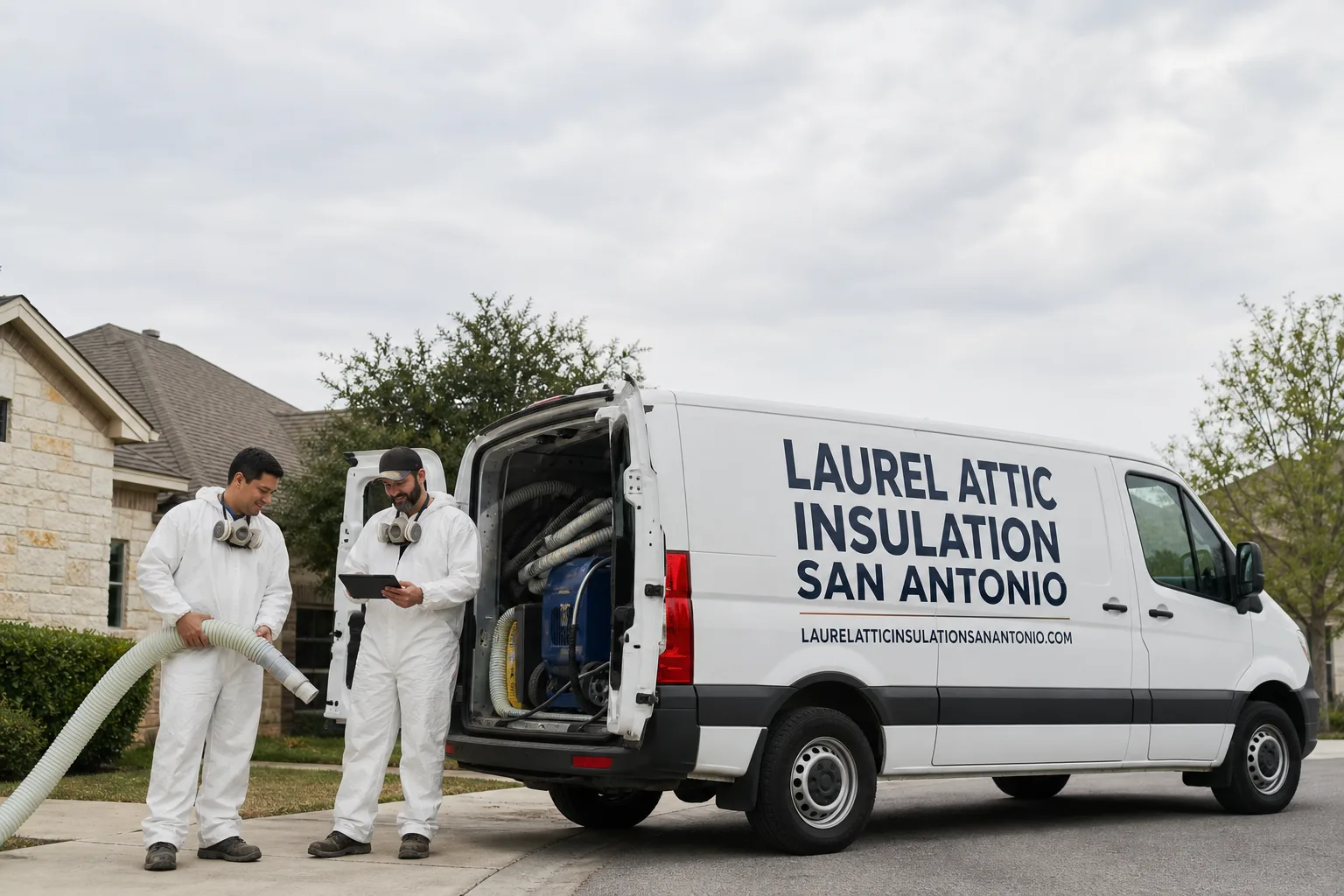
Fast, Reliable Attic Insulation Across Kirby
Most attic insulation jobs in Kirby run $900 – $2,400 depending on square footage, existing R-value, and whether you need air sealing or radiant barrier added. We get to Kirby fast, usually same-day or next-day, because our crews dispatch from San Antonio and know the quickest routes down FM 78 and Ackerman Road. If your ceiling reads 90°F in August and your AC never shuts off, that’s an insulation problem, not just a Texas summer problem. Call (254) 279-0971 and we’ll put eyes on it.
Kirby’s housing stock splits right down the middle. East of FM 78, you’ve got 1950s-70s ranch homes with low-pitch roofs and minimal eave overhangs. West and north near Ackerman Road, you’ve got 2000s-2010s tract builds that met code on paper but leak conditioned air through unsealed top plates and recessed can lights. Each side needs a different fix. That’s why we don’t show up with a one-size-fits-all quote sheet. We show up, crawl the attic, and tell you what’s actually happening up there.
Why Laurel Attic Insulation San Antonio Is Kirby’s Preferred Attic Insulation Company
We’re part of the Relay Home Co. family, founded in 2003, and led by Chase Whitaker. That matters because every job we run in Kirby carries the Relay Visibility Guarantee: a written price before work starts, live technician tracking, and before-and-after photos delivered to your phone. You don’t guess when we’ll arrive. You watch us arrive.
Our Attic Insulation team works in Kirby weekly. We know the older ranch layouts off Old Seguin Road, the newer subdivisions near Ackerman, and how each responds differently to a 105-degree August afternoon. We background-check and uniform every technician. Calls go to a live person 24/7. No voicemail black hole, no four-hour arrival windows. Book in a tap, get a live arrival time, see photos of the work, pay from a link. That’s the Relay Standard, and it’s how every Kirby job runs.
Chase Whitaker has built this operation around a simple idea: Laurel stays green all year, so should your home’s comfort. That’s the idea behind the name. And if a repair doesn’t hold, the 365-Day Done Right Promise means we come back and make it right. In writing. Every job.
Attic Ventilation in Kirby
Attic Ventilation in Kirby means moving enough air through your attic space to keep it from turning into an oven that bakes your ceiling from above. It’s not glamorous. It’s soffit vents, ridge vents, baffles, and sometimes powered ventilators working together. Most Kirby attics don’t have enough of it, especially the older ranch homes with minimal eave overhangs that leave little room for proper intake venting.
Ventilation work in Kirby typically runs $300 – $800 for baffle installation and soffit vent clearing, or $900 – $1,800 for a full ridge and soffit vent package on a typical single-story ranch or 2000s tract home. The job involves checking for blocked soffit vents, installing baffles to keep blown insulation from choking the airflow, and adding ridge vent if the roofline allows. It usually takes 2 – 4 hours, and we do it without walking through your house more than once.
Why Kirby’s Low-Pitch Roofs Cook Attics Faster
A low-pitch roof with minimal eaves leaves a cramped attic triangle with nowhere for heat to go. When outside temps hit 100°F, attic air can hit 140°F or more without proper ventilation. That heat radiates through whatever insulation you have, pushing ceiling surface temps into the 90s. Ventilation is the first line of defense before you even talk about adding R-value.
Baffles, Ridge Vents, and What We Actually Check
We check whether your soffit vents are painted shut, clogged with dirt, or never existed. We look at whether your ridge vent is continuous or just decorative. We measure intake versus exhaust balance, because an attic with great ridge vent and zero soffit intake is like a straw with your thumb over the end. Baffles cost $2 – $4 each plus labor, and most Kirby attics need 10 – 20 of them. Worth every dollar when you see the thermal camera difference.
Radiant Barrier in Kirby
Radiant Barrier in Kirby is a reflective foil layer installed under your roof deck that bounces radiant heat back out instead of letting it soak into your attic air. For Kirby’s hot, humid summers, it’s often the single highest-impact upgrade per dollar on older ranch homes where the roof deck bakes all afternoon. Typical cost runs $1,200 – $2,800 depending on attic square footage and accessibility.
The job involves stapling or laminating the barrier to the underside of the roof deck, leaving an air gap that’s critical for it to work. On a 1,500-square-foot ranch in Kirby, our crew can usually finish in a half day. We see attic temps drop 20 – 30 degrees when it’s done right, which means your existing insulation isn’t fighting a losing battle against 140°F air above it.
Radiant Barrier and Kirby’s Humid Climate
Humidity complicates radiant barrier installation here. The barrier must never trap moisture against the roof deck, and on low-pitch roofs with minimal venting, we have to be careful about condensation. We check the existing ventilation before we recommend it. In some Kirby attics, the fix is ventilation first, radiant barrier second. Doing it backward means you paid for a product that can’t do its job.
What Radiant Barrier Won’t Do
Radiant barrier doesn’t add R-value. It doesn’t replace insulation. It reduces heat gain from radiation, which is the dominant heat source in a Kirby attic in July. Think of it like a windshield shade for your roof. It works alongside your blown-in or batt insulation, and the combination is what actually moves the needle on your cooling bill.
Trusted Brands We Service in Kirby
We stock and install materials from Owens Corning, GreenFiber, and Icynene, matched to what your Kirby attic actually needs. Owens Corning batts show up on a lot of our ranch-home top-up jobs because they fit cleanly between existing joists. GreenFiber cellulose is our go-to for blown-in work on older Kirby homes with irregular framing. Icynene open-cell foam handles the humidity challenge well in Kirby’s climate when we’re air-sealing around can lights and top plates. We don’t push whatever’s on the truck. We pick the material for the house, then bring it. Same-day or next-day turnaround on most Kirby jobs, because our San Antonio yard keeps all three in stock.
Common Attic Insulation Problems We See in Kirby Homes
- Compressed original R-11 batts under plywood storage decks: In 1950s-70s ranch homes east of FM 78, homeowners stack decades of Christmas decorations and old tax returns onto plywood laid over the ceiling joists. The weight crushes the original batts from R-11 down to R-5 or less. A thermal camera often shows ceiling surface temps over 90°F directly below those decks. You’d never know it’s happening unless someone pulls the plywood back.
- Unsealed top plates and recessed can lights in newer tract homes: The 2000s-2010s builds near Ackerman Road passed code with standard batt insulation, but the top plates where walls meet ceiling were never sealed. Recessed can lights leak conditioned air straight into the attic. The house “meets code” but bleeds cold air from every can light. Air sealing fixes it without tearing out drywall.
- Low-pitch roofs with minimal eave overhangs trapping heat: Older Kirby ranch homes often have so little overhang that soffit venting is nearly nonexistent. Combined with a shallow roof pitch, the attic airspace is small and stagnant. Without radiant barrier and ventilation fixes, the attic becomes a heat reservoir that radiates down into living spaces all evening.
- Humidity-driven moisture issues in attics and crawlspaces: Kirby’s humid climate makes vapor barrier placement matter. A poorly placed vapor barrier in a humid attic traps moisture against framing and creates mold conditions. We check where the barrier sits before adding insulation on top of it. Adding insulation over a moisture problem just hides the problem from view.
Pricing for Attic Insulation in Kirby, TX
Here’s what Kirby homeowners can expect to pay. Blown-in attic insulation to R-38 on a 1,200 – 1,800 square foot home typically runs $1,200 – $2,300. Batt insulation replacement on a similar home runs $1,400 – $2,600. Attic insulation top-up over existing batts runs $900 – $1,600 depending on how much R-value you’re adding. Attic baffles and ventilation prep run $300 – $800. Radiant barrier runs $1,200 – $2,800. Air sealing around top plates and can lights runs $400 – $900. Every quote is written and delivered before we start. No door-step changes. Call (254) 279-0971 for an exact number on your Kirby home. Estimates are free, and you’ll get the number in writing.
We Also Serve Cities Near Kirby
Our Kirby crews also cover nearby cities including San Antonio, Selma, Converse, and Leon Valley. If you’re just outside Kirby proper, call (254) 279-0971 and we’ll confirm coverage and give you a live arrival window. Same Relay Standard applies no matter which side of the city line you’re on.
Serving Kirby, TX - Our Local Coverage Area
We’re based in the Kirby area and know this community well. Use the map below to see our service coverage - if you’re nearby, we can almost certainly help.
FAQs About Attic Insulation in Kirby
Because the batts aren’t fine. In Kirby’s 1950s-70s ranch homes east of FM 78, original R-11 insulation gets compressed under plywood storage decks, often dropping below R-5. It looks okay from the attic hatch, but it’s not doing its job. The fix is pulling back the deck, removing or topping up the compressed batts, air sealing, and often adding radiant barrier. Call (254) 279-0971 and we’ll bring a thermal camera and show you exactly where the heat is coming through.
Code-level insulation in a 2010s Kirby tract home means batts were installed, but it doesn’t mean top plates and recessed can lights were sealed. Those leaks bypass the insulation entirely. We regularly see 2010s homes off Ackerman Road losing 20 – 30% of conditioned air through unsealed can lights and top plates. Sealing them costs $400 – $900, takes most of a morning, and usually pays for itself within two summers. We’ll show you photos of the gaps before we seal them.
Kirby’s humidity means a vapor barrier placed on the wrong side of the insulation traps moisture and feeds mold. In attics, vapor barriers are rarely needed if ventilation is adequate. In crawlspaces, they matter more. We check where the barrier currently sits before recommending any insulation changes. Adding R-value over a moisture problem doesn’t fix the problem. It just makes it harder to find.
For a low-pitch roof with minimal eave overhangs, the best upgrade is usually radiant barrier plus improved ventilation, not just more batts. The tiny attic airspace means heat concentrates fast. A radiant barrier bounces heat off the roof deck before it enters the attic air, and baffles plus soffit vent work give the attic a way to exhale. Together they typically run $1,500 – $3,600 on a Kirby ranch home, and we’ve seen ceiling temps drop 14 degrees on a single job near Old Seguin Road. Call (254) 279-0971 and we’ll tell you what your roofline can actually handle.
Yes, you keep your storage. We lift the plywood deck, address the compressed batts underneath, and either raise the deck on small risers or add insulation around the framing so the deck can sit back down without crushing the new material. On a ranch home near Old Seguin Road, we pulled back a plywood storage deck to find original R-11 Owens Corning batts crushed to less than R-5 under decades of boxes. We air-sealed the can lights and top plates, blew in GreenFiber cellulose to R-38, and added a radiant barrier. Ceiling temps dropped from 92°F to 78°F before the customer’s next AC cycle. The boxes went back on the deck. Call (254) 279-0971 for a free estimate on yours.
Written by Chase Whitaker, Owner at Laurel Attic Insulation San Antonio, serving Kirby since 2003.