
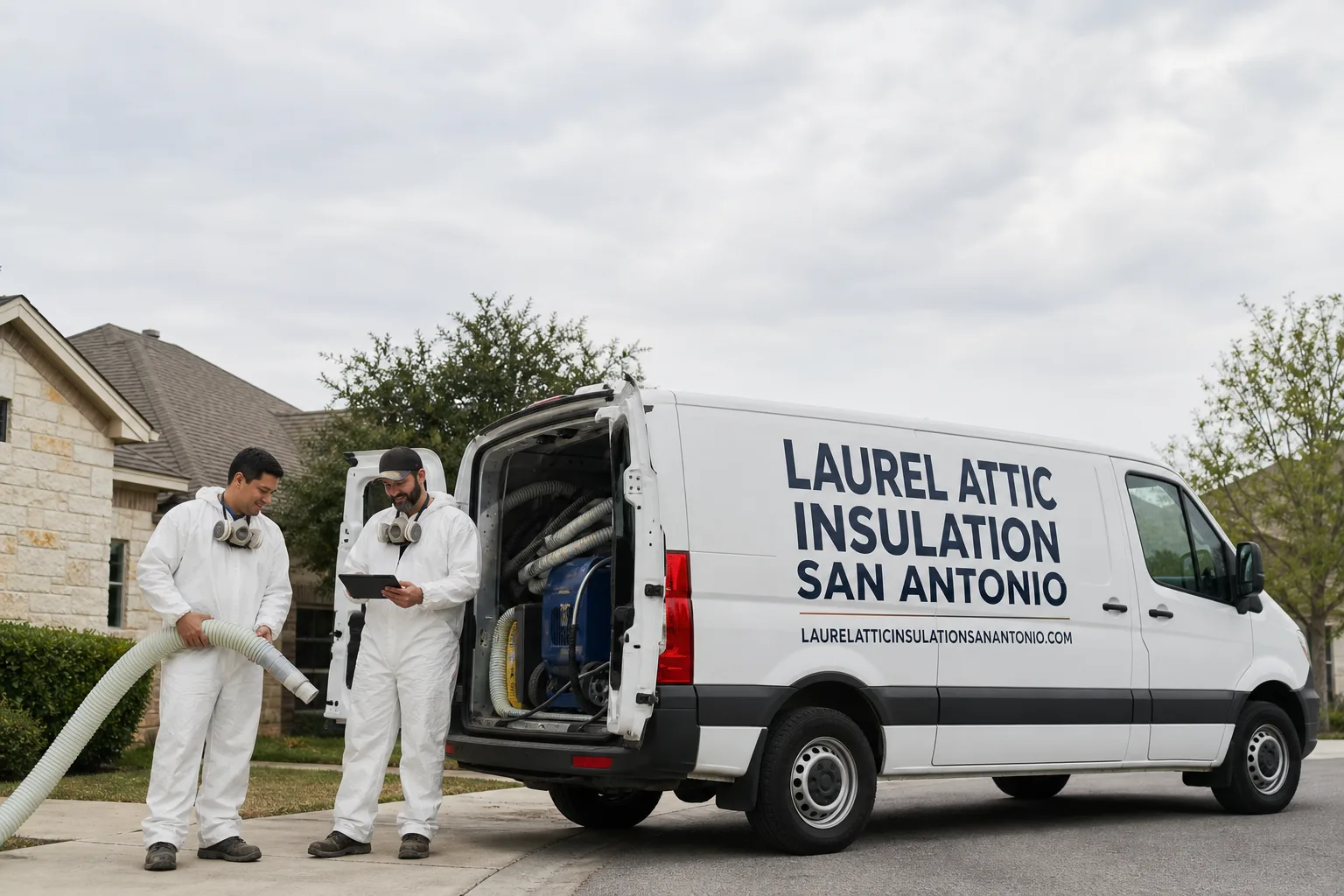
Attic Insulation Near You in San Antonio, TX
If you’re searching for Attic Insulation near you in San Antonio, you want two things: a crew that can get there fast and a price you can trust before the work begins. Laurel Attic Insulation San Antonio serves the entire metro area with live phone support 24/7, written pricing before any work starts, and technicians who arrive at a live, trackable time instead of a vague four-hour window. Call (254) 279-0971 and you’ll talk to a real person who can schedule your estimate.
We’re part of the Relay Home Co. family, founded in 2003, and we’ve spent two decades insulating attics across San Antonio, Selma, Converse, Leon Valley, Alamo Heights, Windcrest, Castle Hills, and Scenic Oaks. When you book with us, you get the Relay Standard: book in a tap, get a live arrival time, receive before-and-after photos, and pay from the link. No door-step surprises, no phone tag, no guessing when the crew will show up.
Fast, Local Attic Insulation
Most attic insulation jobs in San Antonio run $900 to $2,400 depending on square footage and the R-value needed. R-value: that’s the number that measures how well insulation slows heat from moving through your ceiling. San Antonio summers push attic temperatures past 140 degrees, and a low R-value means your AC works overtime just to keep the living space cool. We match the material to the job, not to whatever’s on the truck, drawing from eight brands: Owens Corning, Johns Manville, Knauf, Rockwool, CertainTeed, Icynene, Demilec, and GreenFiber.
We keep response times tight because we staff locally. A crew can often be out the same day for an inspection, and installation is typically scheduled within the week. The technicians are background-checked and uniformed, and you’ll see their live location before they arrive. Our home page walks through the booking flow if you want to see how it works before you call. If you need the full scope of what we do, start with our Attic Insulation in San Antonio guide for a deeper look at material options and R-value recommendations for this climate.
Every job includes a written price before work starts, a written guarantee on the installation, and a free second visit if anything fails within 365 days. That’s the 365-Day Done Right Promise, and it’s in writing on every job, not buried in fine print.
What Attic Insulation Actually Does for a San Antonio Home
The job of attic insulation is straightforward: it slows heat transfer between your attic and your living space. In the summer, that means keeping furnace-level attic heat from bleeding down through your ceilings. In the winter, which San Antonio gets a real taste of, it means holding the heat from your furnace inside the home instead of letting it escape through the roof.
Most homes in San Antonio built before 2010 were insulated to older code standards. That typically means R-30 fiberglass batts that have settled, compressed, or been disturbed by rodents, roof repairs, or cable installers. The current Department of Energy recommendation for this climate zone is R-38 to R-60 in the attic, depending on where you are in the metro. A 1,500-square-foot attic brought from R-19 to R-38 usually runs between $1,100 and $1,900. Larger attics or projects that include air sealing run higher.
Blown-In Attic Insulation with fiberglass is the most common choice for San Antonio attics. It settles into awkward corners, covers existing insulation evenly, and installs fast. Blown-in cellulose from GreenFiber offers a higher R-value per inch and costs slightly more per square foot. Spray foam from Icynene or Demilec is the premium option, and it’s the right call for unvented attics or homes where the HVAC equipment lives in the attic space. We’ll show you the numbers for all three and let you decide, with our recommendation based on what your attic actually needs.
How Much Does Attic Insulation Cost in San Antonio?
Here’s the straightforward answer most contractors won’t give you until they’re standing in your doorway. Attic insulation in San Antonio typically costs $900 to $2,400 for a standard 1,200 to 2,000 square foot attic. Smaller attics or Attic Insulation Top-Up jobs can come in under $800. Older homes with air sealing needs, pest damage, or existing insulation that has to be removed first can push past $3,000.
The variables that move the price are square footage, the R-value you’re targeting, the material you pick, and whether the old insulation needs to come out first. Here’s how those break down in real numbers.
- Blown-in fiberglass (Owens Corning, Johns Manville, Knauf): $0.90 to $1.60 per square foot including labor, for a typical R-38 install.
- Blown-in cellulose (GreenFiber): $1.10 to $1.80 per square foot including labor, with a higher R-value per inch than fiberglass.
- Spray foam open-cell (Icynene, Demilec): $1.80 to $2.80 per board foot for roof-deck or attic-floor applications; the most expensive option up front, but the strongest air seal.
- Insulation removal, when needed: $1.80 to $3.20 per square foot when old material is wet, rodent-soiled, or full of construction debris. Removing and replacing runs more than adding a top layer.
- Air sealing the attic floor: $600 to $1,200 depending on how many penetrations need foam and caulk, and whether we’re doing it as part of the insulation install.
Those are real numbers for this market, not a national average that doesn’t reflect San Antonio labor or conditions. We deliver a written price before any work starts, so what you see on the estimate is what you pay. No add-ons at the door. If you want an exact number for your attic, call (254) 279-0971 and we’ll schedule a walkthrough. Estimates are free.
Areas We Cover
Laurel Attic Insulation San Antonio works across the entire metro. Our crews are regularly in Selma and Scenic Oaks, where newer construction on the northeast and northwest sides often has minimal insulation in the attic. Converse and Windcrest homes from the 1970s and 80s frequently need a top-up to current R-value standards. In Alamo Heights and Castle Hills, older homes with limited attic access and original insulation are common. Leon Valley and central San Antonio keep us busy with mid-century houses that were insulated once, decades ago, and never touched again. If you’re inside the 1604 loop or just outside it, we’re local to you.
Signs Your Attic Insulation Needs Attention
The most obvious signal is a room that never gets cool in August, the one where you set the thermostat to 72 and it reads 78 by 4 p.m. That’s heat radiating down from the attic. Other signs, in rough order of reliability: an AC that runs constantly but can’t hold temperature, ice dams on the roof in a rare San Antonio freeze, pests in the attic, and energy bills that climbed year over year without a change in your usage.
If you see damp spots or mold on the attic side of the ceiling, that’s not just an insulation issue; it’s often a ventilation problem. Insulation can be replaced, but the ventilation has to be corrected or the same problem returns. We’ll tell you which one you have during the inspection, and we’ll show you photos from the attic before we recommend anything.
The Relay Standard: What You Get When You Book
The reason most San Antonio homeowners hesitate to call an insulation contractor is simple: they’ve been burned by a no-show or a price that changed at the door. We built our process around eliminating that.
When you book with Laurel Attic Insulation, you get a live arrival time the same way you’d track a delivery driver. The technician shows up in uniform, does a full attic inspection, and walks you through what he found, with photos. You get a written price before anything starts. After the job’s done, you get before-and-after photos delivered with your digital invoice, and you pay from a link on your phone. The workmanship is covered for 365 days. If it’s not right, we make it right. If the repair fails, the second visit is free. That’s the Relay Visibility Guarantee, and it’s included on every job we do.
No four-hour windows. No voicemail queue. Our phone support is live 24/7, which means someone answers at 7 a.m. and at midnight. If you want to ask a quick question about R-value or blown-in versus spray foam, you get a person, not a recording.
Blown-In vs. Spray Foam: Which One for San Antonio?
We use both, and the right answer depends on your attic. Blown-in fiberglass or cellulose is the default for vented attics with standard construction. It’s the best cost-to-R-value play for most homes, it installs in a single day, and it’s easy to top up later. Spray foam earns its price in specific situations: unvented attics, attic spaces that house HVAC equipment or ductwork, homes where the attic is used for storage and needs a finished feel, and houses with chronic air leakage between the attic and living space.
San Antonio’s climate puts real stress on ductwork in attics. Many local homes run ducts through an unconditioned attic that hits 140 degrees in July. When we insulate attics in neighborhoods like Castle Hills or Alamo Heights where the house is older and the ducts are original, we often recommend spray foam on the roof deck to bring the ducts inside the conditioned envelope. It’s a bigger up-front investment, but it can cut cooling costs dramatically in those specific homes. We’ll give you numbers for both approaches and let the attic tell us which one makes sense.
One thing we don’t do is push spray foam on a house that doesn’t need it. Blown-in fiberglass at R-38 will fix most San Antonio comfort problems for under $1,600. We’ll tell you that when it’s true, and we’ll show you the numbers either way.
Insulation Removal: When It’s Necessary
There are three reasons we remove insulation rather than blow over it, which may lead to Attic Insulation Replacement. The first is water damage. A roof leak that soaked through old fiberglass leaves a material that never fully dries and loses its R-value permanently. The second is rodent or wildlife activity. Rat droppings, urine, nesting material, and chewed insulation are a health hazard, and you don’t want to bury that under a fresh layer. The third is contamination from old vermiculite, which in homes built before 1980 may contain asbestos in San Antonio attics. We don’t touch vermiculite removal in-house, but we’ll tell you if we see it and connect you with the right specialist before we proceed.
For standard removal, we use commercial vacuum equipment that runs from the truck to the attic. A typical 1,200-square-foot removal runs $2,200 to $4,000 including disposal, depending on depth and condition. It takes one day, and we handle the disposal at a licensed facility. After removal, we can install new insulation the same week. The written price covers everything: removal, haul-away, cleanup, and the new install.
If you’re in an older neighborhood like Leon Valley or the north side near Windcrest, and your attic hasn’t been looked at in 20 years, we might recommend removal before we recommend replacement. We’ll show you photos from the attic so you can see exactly why.
Why San Antonio’s Climate Makes Attic Insulation Different
Attic insulation isn’t one-size-fits-all across the country. San Antonio sits in what the Department of Energy calls IECC climate zone 2. That means long, hot summers, short but sometimes harsh winters, and high humidity that affects how insulation performs. The recommended attic R-value for this zone is R-38 for standard homes, with R-49 recommended for homes with electric heat or older HVAC systems that run less efficiently.
Humidity plays into it too. San Antonio’s summers stay near 90% relative humidity many mornings. When warm, moist air leaks into an under-insulated attic, it condenses on the underside of the roof deck and saturates insulation. Good insulation combined with proper attic ventilation prevents that cycle. It’s one reason we check venting on every job. Insulation that’s working correctly should be dry, fluffy, and in contact with the attic floor, not packed into the eaves blocking airflow.
The payoff is measured in real dollars. The DOE estimates that properly insulating an attic in this climate zone cuts heating and cooling energy use by 20 to 30 percent in a typical home. For a San Antonio house spending $220 a month on CPS Energy, that’s $530 to $790 back in your pocket each year. Those are broad numbers, but the logic holds: the attic is the single biggest energy leak in most homes, and fixing it pays for itself faster than any window replacement or HVAC upgrade.
What to Expect During Installation
The process is simple enough to describe in a few paragraphs. The crew arrives at a live, trackable time. They run protective covering from the front door to the attic access point, set up the vacuum or blower equipment, and confirm the scope with you before any material goes in. The installation itself takes three to six hours for a standard blown-in job. Spray foam runs longer, sometimes a full day or a second day for large attics or roof-deck applications.
After the material is in, the crew checks depth with a measuring tool to confirm the R-value they quoted, takes photos of the finished attic, and walks you through what was done. You get the photos, the depth readings, and the written warranty before the truck leaves the driveway. Pay from the link on your phone. That’s it. No chasing a paper invoice, no wondering how much it actually cost until the bill came in the mail.
Key Takeaways
- Attic insulation in San Antonio typically runs $900 to $2,400 for a standard install; blown-in fiberglass is the most common choice, and spray foam is the premium option for unvented attics or homes with ductwork in the attic.
- Every job includes a written price before work starts, live arrival tracking, before-and-after photos, and a 365-day workmanship promise with a free second visit if anything fails.
- We serve the entire San Antonio metro, including Selma, Converse, Leon Valley, Alamo Heights, Windcrest, Castle Hills, and Scenic Oaks.
- Phone support is live 24/7. You’ll talk to a person, not a recording.
- If old insulation is wet, rodent-soiled, or otherwise compromised, removal may be necessary before new install. We’ll show you photos and a written scope before any work starts.
FAQs
How fast can you get to my house in San Antonio?
In most San Antonio neighborhoods, we can have a technician out the same day for an estimate, and installation is typically scheduled within the week. Live phone support is available 24/7, so you can reach a real person right now at (254) 279-0971 to lock in a time.
Do you serve my area?
We cover the entire San Antonio metro, including Selma, Converse, Leon Valley, Alamo Heights, Windcrest, Castle Hills, and Scenic Oaks. If you’re inside or just outside the 1604 loop, chances are strong you’re in our coverage area. Call (254) 279-0971 and we’ll confirm it while you’re on the phone.
How much does attic insulation cost in San Antonio?
Most attic insulation jobs run $900 to $2,400 depending on square footage and R-value. You’ll get a written price before any work begins, so the number you see on the estimate is the number you pay. Estimates are free.
Can I reach you after hours?
Yes. Our phone support is live 24/7. You’ll talk to a person, not a voicemail, whether you call at noon or at 2 a.m. Reach us anytime at (254) 279-0971 with questions about pricing, materials, or scheduling.
Ready to Fix Your Attic? Call Today
If your upstairs rooms won’t cool down, your energy bills keep climbing, or you just want a professional to look at what’s actually in your attic, call Laurel Attic Insulation San Antonio at (254) 279-0971. You’ll get a real person, a free estimate, and a written price before any work begins. Book the inspection and you’ll see live arrival tracking, photos from the attic, and a quote you can trust. That’s the Relay Standard, and it’s how attic insulation should work.
Written by Chase Whitaker, Owner at Laurel Attic Insulation San Antonio, serving San Antonio and nearby areas.
What Our Customers Say
"Utility bill dropped the next month. Our summer electric bill was lower by a visible amount."
- Gary J."Quote in the app was clear on R-value and price."
- Doris L."Easy to book and easy to pay. The invoice came by text and I paid it from the driveway."
- Rudy B.